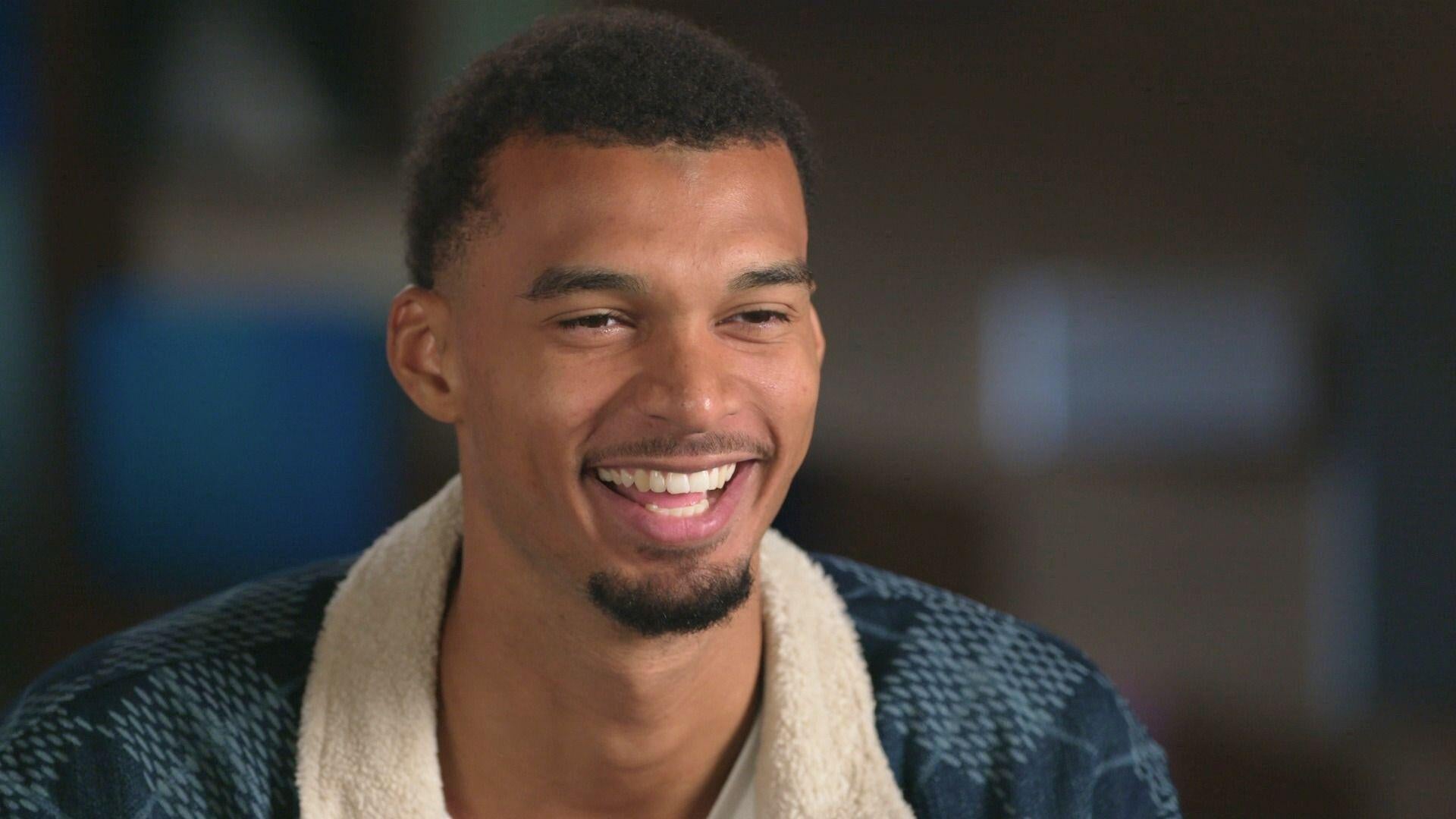
▶ Watch Video: Victor Wembanyama: The 60 Minutes Interview
San Antonio Spurs star center Victor Wembanyama is known as “the Alien,” a nod to his supernatural size and supernatural basketball skills. At 7-foot-4, Wembanyama can dunk without jumping, yet he also can freeze defenders with his ballhandling, drain three-pointers, and he is the NBA’s reigning Defensive Player of the Year. But as nicknames go, “The Alien,” misses the mark like a clunky jump shot, in that Wemby — there’s your nickname — is a man making the most of his earthly minutes. He comes from France, plays pick-up chess in Manhattan parks, and trains at Chinese monasteries. With LeBron James turning 42 and Steph Curry now 38, Wemby, age 22, is the new face of the NBA. We dropped in on him this preseason and found that while he may be best known for his height and length, it’s nothing compared to his depth.
Basketball has seen tall; basketball has seen talent.
Victor Wembanyama: Hello…
Jon Wertheim: Hey, Jon.
Basketball has never seen Victor Wembanyama’s holy matrimony of size and skill.
Jon Wertheim: Enchanté…
Victor Wembanyama: Enchanté Monsieur…
And yet his favorite play hinges on his teammates.
Jon Wertheim: What part of basketball specifically brings you the greatest joy?
Victor Wembanyama: I think alley-oops in particular.
Victor Wembanyama: Alley-oops are a team play and also a dunk.
Victor Wembanyama: I like alley-oops.
Jon Wertheim: It’s like a telepathy–
Victor Wembanyama: Yeah, exactly–
Then again, here’s a player who can eliminate the middleman and alley-oop himself.
Yeah. So it goes for Wemby. Big men aren’t supposed to shoot like this, much less dribble like this. It’s devastating offense meets demoralizing defense.
Jon Wertheim: No one’s ever played the game like you. No one has had your combination of size and skill set. There’s no blueprint here. So how are you figuring out–
Victor Wembanyama: That’s true.
Jon Wertheim: –how to train, how to pace yourself, how to even envision your career when no one’s done it before you?
Victor Wembanyama: It’s true, it is– a difficulty, first of all because of the player that I am. But also being– a foreigner here, growing up in a totally different environment. And– I think the key is being comfortable not knowing, being comfortable finding out my own answers.
Jon Wertheim: Are you comfortable?
Victor Wembanyama: I am comfortable not knowing my answers. I am comfortable walking through the fog.
Jon Wertheim: What’s it like when you make it through the fog, when you figure something out?
Victor Wembanyama: There’s brief moments where my head peaks through and– sees the sun. Yeah, the– they’re great. Last year there was this I think the month of February, we didn’t lose a s– single game. This is these moments where everything clicks, (SNAPPING), you know.
The Spurs kept clicking through the spring, thanks largely to Wembanyama’s heroics.
San Antonio beat the Oklahoma City Thunder to win the Western Conference. But then, despite being favored in the Finals, they lost in five games to the New York Knicks. By his own admission Wembanyama, was far from his best. Not least because of this pick-on-someone-your-own-size cheap shot against Knicks star Jalen Brunson.
Jon Wertheim: Last year in the Finals you were portrayed– as a villain. Correct me if I’m wrong, I didn’t get the feeling that bothered you.
Victor Wembanyama: No, it didn’t because I’m not paying attention to this– during the Finals. I don’t think any player on either team really is.
Jon Wertheim: I wondered if you didn’t show, “Hey, this is part of my character too.” Edgy Wemby, whatever it is. But you showed a new side of yourself.
Victor Wembanyama: It showed my limits more than anything else. Going out there, you need to play basketball. You don’t need to beat the s**t out of people. (LAUGH) If you wanna win, at least.
That self-awareness comes from someone just starting his fourth NBA season – and scary for the rest of the league – just clearing his throat. He first appeared on scouts’ radars as a young teen, a bright prospect from France. The son of a former track athlete (Dad, Félix, 6-foot-6) and a former basketball player mother (Élodie, 6-foot-3), Wemby was the most anticipated rookie since LeBron James 20 years earlier. It was a given he would be the top pick in the 2023 Draft.
The jump from the Paris suburbs to central Texas — and one of the NBA’s smallest markets — might be a considerable one.
For Wemby, it was the perfect pairing of player and franchise.
Victor Wembanyama: The franchise with the greatest coach of all time, the franchise with– a big French history as well. And– yeah, just winning. A winner’s franchise, you know?
Jon Wertheim: Greatest coach of all time, you’re– you’re talking about Pop.
Victor Wembanyama: Yeah.
Jon Wertheim: You’re talking about Gregg Popovich, who you played for and–
Victor Wembanyama: Yes.
Jon Wertheim: –got very close to. What’s the most important thing he ever told you?
Victor Wembanyama: One lesson that often comes up is– about humility. He often said something when we were in film, “After a win you’re rarely as good as you thought you were, and after a loss you’re rarely as bad as you thought you were.”
Popovich suffered a stroke and retired from coaching in 2025, but not before leading San Antonio to five NBA titles. The Spurs also nurtured two all-time centers, and a bevy of international stars.
Amid all that history, Wemby still stands out. Starting with the unique way he trains. After a blood clot in his shoulder shut down his second season, Wembanyama doubled down on his conditioning. We found him to be preoccupied — obsessed even — with the ground level: that is, his feet. He told us they hold the key not just to his mobility, but his entire career.
Victor Wembanyama: Because– big men have always had feet problems. And– I also find more and more that feet are responsible for so much more that goes on. It’s funny, because I was just talking to a rookie. I went to– to practice barefoot, and he sees me walking without shoes, and he’s like, “I didn’t know you could just not wear shoes.” (LAUGH)
An evangelist for going barefoot, Wemby went to work converting us.
Victor Wembanyama: I try to walk barefoot as much as I can, and wear– minimalistic shoes. Those aren’t minimalist, those are maximalist. Those got a thick sole, you know? They’re looking nice though, if you wanna– they look very nice.
Jon Wertheim: But these are what you wear, just go really easy on the feet, you’re not gonna– and you just slip those on–
Victor Wembanyama: This is what I wear for 60 Minutes” interviews. (LAUGH)
His shoe size, as you’re likely wondering, 20.
Victor Wembanyama: Basically you need to– you need to strengthen your feet, and what shoes do, like, shoes like yours, for example, they don’t respect the natural shape of the foot.
When he was done insulting my favorite pair of shoes, he concluded his dissertation.
Victor Wembanyama: If you got a good foot strength, which brings a good foot posture, everything else can develop the right way. Knee, hip, and back, everything.
Jon Wertheim: You appreciate that, never mind athletes, not all people have your level of curiosity.
Victor Wembanyama: Yeah. It’s the defining trait of mine.
In the summer of 2025, curiosity took him to China, where he went to live, learn kung fu — and meditate — alongside Buddhist monks.
Jon Wertheim: How did you do with it?
Victor Wembanyama: It was hard, be– because they push you to the next level. It was really hard. I think the first– the very first day it was an hour 40 of meditation, silence to complete silence. It was crazy. It was really hard.
Jon Wertheim: You’d never done anything like that.
Victor Wembanyama: Nothing close to that.
Jon Wertheim: What was the longest you could go meditating?
Victor Wembanyama: I was probably locked in for 30 minutes. And then– an hour and a half wondering, “How much longer (LAUGH) is it gonna go on for?” Yeah.
Jon Wertheim: Someone told me you meditate briefly in between free throws?
Victor Wembanyama: You could call that meditation, I guess.
Jon Wertheim: Where do your thoughts go?
Victor Wembanyama: I think centering back– you know, thinking that it’s– it’s– at the end of the day it’s a regular shot. Because when you try to make it too technical it becomes like a robot.
Jon Wertheim: You’re trying to think about nothing or think about something very specifically?
Victor Wembanyama: Nothing for a second, and then focusing on making the shot.
Jon Wertheim: Do you know your free throw percentage?
Victor Wembanyama: 82%–
Jon Wertheim: I was gonna say, it was, like, 82%. You’re doing something right.
Victor Wembanyama: It could be better.
Not by much: historically, NBA centers have averaged less than 70%.
This past summer, Wemby returned to France, where — no surprise — he’s wildly popular. We joined him in Nanterre, the district outside Paris where he was first spotted as a teenager. He runs an annual tournament here that combines his sport with another of his curiosities. He popped in for a game of one-on-one with a fellow-prodigy. This one, age 9.
Jon Wertheim: As opponents go, how tough was Louise?
Victor Wembanyama: Was she the last one with the glasses?
Jon Wertheim: Yeah. (LAUGH)
Victor Wembanyama: She was– she was tough.
The New York Knicks needed five games to beat Wemby; Louise? 16 minutes.
Jon Wertheim: Explain the basketball-chess overlap. Is there a basketball-chess overlap?
Victor Wembanyama: Yes, there is. I find that chess is a lot about decision making. And that looks like basketball a lot, at least in theory. Because there are some theoretical good moves.
On the same trip home, he hosted his Spurs teammates, first on the court, then on the Seine.
Jon Wertheim: What did you want to show them about your country, your culture?
Victor Wembanyama: I wanted to show them, you know, the– the refinement at times, but also how I– I– I would take care of them, you know? Because it’s– it– it really matters to me. But it did more for me than for them that they came, because–
Jon Wertheim: Why?
Victor Wembanyama: Because I don’t know, I just take it very– it goes straight to my heart.
Jon Wertheim: What about the reverse, when friends and family in– in France say, “What’s it like living in the U.S.?”
Victor Wembanyama: When they ask me what’s– what it’s like to live in the U.S., my answer is always, “Well, I don’t know, because I– I don’t live a normal life in the U.S.” I live the life of an athlete, of– a rich person– you know of– the life of somebody that’s gonna have everything taken care of– you know, no matter what I do, really. So it’s not– it’s not the life of– an– the regular American. But– it’s– it’s the best country to be an athlete in.
Jon Wertheim: You acknowledge you don’t live a typical existence here. But– but even so, what about this country has struck you?
Victor Wembanyama: Good or bad?
Jon Wertheim: One of each.
Victor Wembanyama: Good is how, like, you n– it feels like you’re never judged for being ambitious. Bad, I would say– I think the social interactions are more shallow here, more– not as in depth as– what I’ve seen in other countries.
Shortly after we visited with Wemby in Texas, student protests broke out in his home country.
“I hear them… and I support them,” he said of the students. This candor is part of the Wemby deal. Double-teamed, yet unguarded, unafraid to display emotion. And he can trace the origin.
Jon Wertheim: Was there a moment when you said, “I don’t wanna be guarded anymore”?
Victor Wembanyama: Yeah. There is. Yeah. I think the– the– the condition I had, early 2025– the thrombosis, it’s– had a huge– huge impact on this.
He’s referring to that blood clot, which changed his outlook.
Victor Wembanyama: After that it’s like, life is so short, I don’t– I don’t even wanna waste it being somebody else, you know? Simple as that.
The new NBA season is less than two weeks old. The league’s new face — and tallest starting player — comes with outsized ambitions, both for his team and for himself.
Jon Wertheim: You were up front last year. I should’ve won the MVP. You made a strong case. I’m guessing your– your views haven’t changed on that.
Victor Wembanyama: You should’ve won the MVP?
Jon Wertheim: That’s what you said.
Victor Wembanyama: Did I?
Jon Wertheim: Should you have won the MVP last year?
Victor Wembanyama: No. I should win it this year though. (LAUGH)
Produced by Nathalie Sommer and Kaylee Tully. Broadcast associate, Mimi Lamarre. News associate, Eric Frank. Edited by Peter M. Berman.