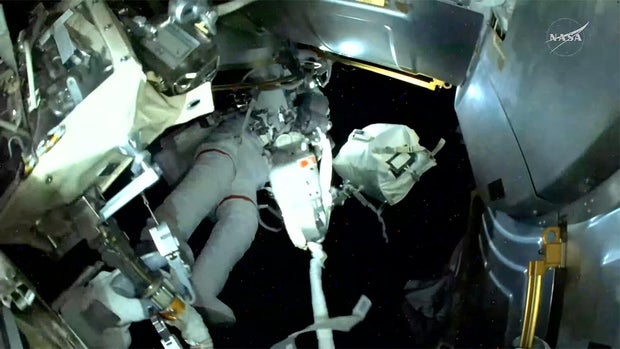
Two astronauts stepped outside the International Space Station Thursday for the first of two spacewalks, one week apart, to install a final pair of roll-out solar blankets that will complete a complex, years-long upgrade of the lab’s aging power system.
Floating in the station’s Quest airlock, NASA’s Anil Menon and Canadian Space Agency astronaut Joshua Kutryk switched their suits to battery power at 7:57 a.m. EDT, officially kicking off a planned six-and-a-half-hour spacewalk, the eighth so far this year and the 285th since ISS assembly began in 1998.
The spacewalk began in orbital darkness, prompting Kutryk to observe “the night is dark and full of wonders.”
The goal of the excursion and a follow-on spacewalk next week is to complete an upgrade that began in 2021 when the first of eight ISS roll-out solar arrays, or IROSAs, was installed. The IROSAs are smaller than the station’s original solar panels but they are more efficient, featuring state-of-the-art solar cells.
Before the first IROSA was installed, the original arrays were generating about 152 kilowatts of power. The six IROSAs installed to date have boosted that up to about 200 kilowatts. With the final two sets, some 215 kilowatts of power will be available to sustain the lab through its planned retirement and de-orbiting in 2030, supporting life support systems, research and visiting vehicles.
The final two IROSA’s were delivered to the station aboard a SpaceX Cargo Dragon capsule earlier this month with each one folded in half and stowed in the ship’s unpressurized trunk section.
The station’s robot arm, operated remotely by flight controllers at the Johnson Space Center in Houston, pulled the IROSAs out of the Dragon and stowed them on the left side of lab’s power truss to await installation.
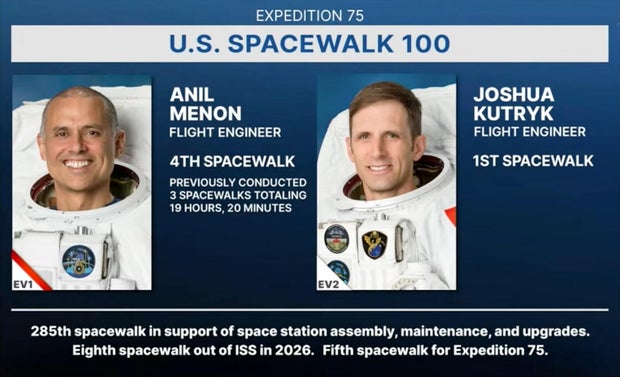
Menon, a veteran of three spacewalks earlier this year, and Kutryk, carrying out his first extra-vehicular activity, or EVA, planned to install the seventh IROSA on a previously assembled support fixture at the base of one of the station’s left-side inboard solar wings.
To do so, the flight plan called for Kutryk and Menon to unbolt one of the stowed IROSAs so Menon, anchored to the end of the station’s 58-foot-long robot arm, can carry it over to its mounting point farther outboard along the power truss.
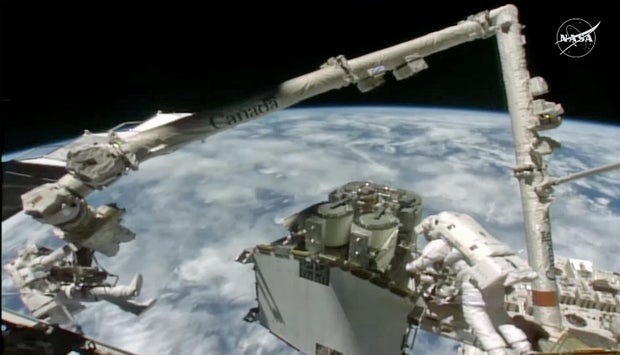
“They are around 750 pounds in that folded configuration, they’re about 10 feet long, and so it’s a lot to handle,” said Garrett Hehn, a spacewalk flight director.
He said flight controllers developed “a pretty elegant series of maneuvers” to move Menon and the IROSA on the robot arm “where we’ve tried to rotate around the actual center mass of the arrays rather than the crew member. It was a lesson learned from previous EVAs of how we could make it a little less tiring on Anil when he’s got to hold that array in his hands.”
Once in position, Menon and Kutryk planned to mount the IROSA on its support frame, unfold its two halves and bolt them together.
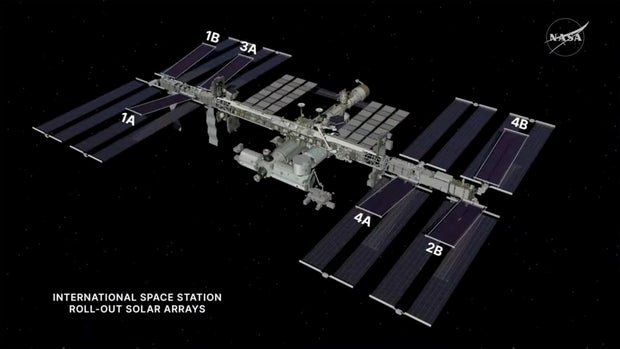
Then, working when the station is on Earth’s night side and the arrays aren’t generating any power, the spacewalkers will make the electrical connections that will tie the IROSA into power channel 2A. Once that work is complete, the arrays will be unrolled.
The IROSAs deploy somewhat like a tape measure in reverse, with “stored energy” built in that lets the blankets unroll without motors or other drive mechanisms.
“These arrays, I kind of think of them like a snap bracelet, if you remember that time,” Hehn said. “They basically have a series of magnets up the side where they deploy with enough energy that it just continues rolling out steadily. That process will take about 10 minutes.”
Menon and Kutryk plan to float back outside Nov. 5 to install the final IROSA on a solar wing at the far right end of the power truss. The robot arm does not have the reach to carry Menon and the new blankets to the far end of the truss, so he and Kutryk will hand it off to each other leap frog fashion to get it all the way to the waiting support frame.
From there, installation and deployment will mirror the work done Thursday.
Menon and Kutyrk “will head back out on Thursday, November 5, and this will be to install and deploy the final set of IROSAs,” said Gaurang Patel, a senior manager in NASA’s Low Earth Orbit Program. “This will essentially complete our power augmentation upgrades.”