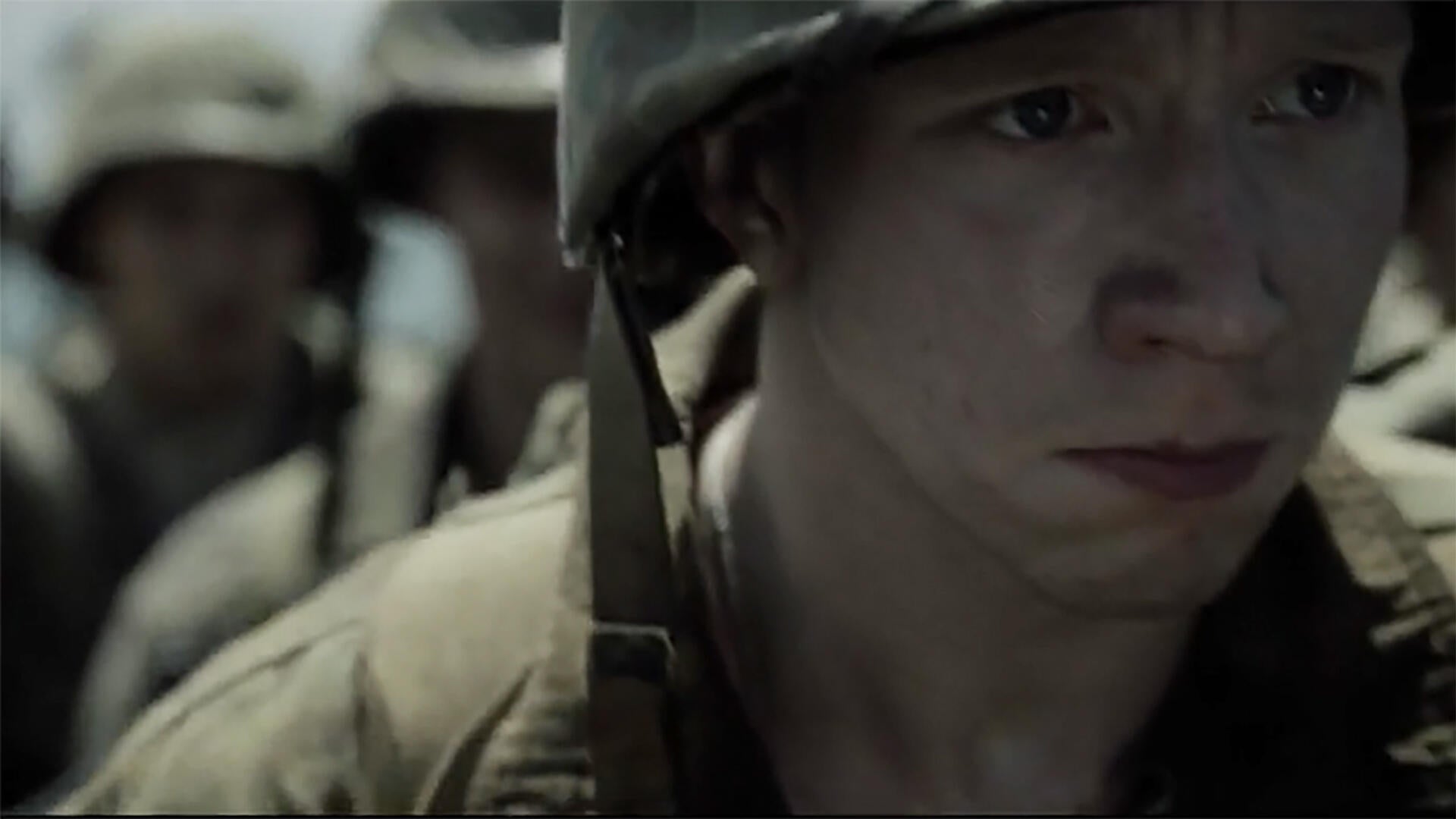
▶ Watch Video: “The Mosquito Bowl” and the human cost of war
Okinawa proved to be the last and costliest battle of World War II in the Pacific – and it’s a name director Peter Berg wants us all to remember. His new movie, “The Mosquito Bowl,” captures that battle. “It is a film that I hope asks us all to look at what we ask of our young men and women,” he said.
“The Mosquito Bowl” is based on the book by Buzz Bissinger, who also wrote “Friday Night Lights,” which became Berg’s breakout movie. But don’t let the title fool you – it’s not a movie about a football game. “No, it’s not; it’s a movie about the cost of war, the human cost of war,” said Berg.
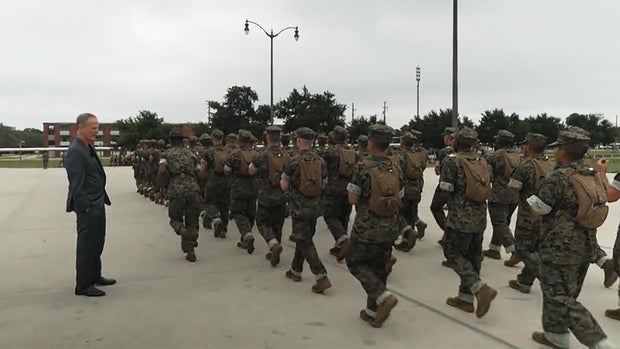
The human cost of war as told through the true story of four All-American football players who volunteered for the Marines after Pearl Harbor, and reported to boot camp at Parris Island, South Carolina, which is where we interviewed Berg. “They came down here and they joined the Marine Corps, thinking, Hey, we’ll go win this thing. We’ll go whup some butt and win this thing, like we win our football games,” Berg said. “Then they come across an enemy, the Japanese, who are instructed by their emperor, who they believe is a god, to not surrender.”
They first encountered the Japanese on a tiny speck of coral called Tarawa. When footage of American dead on the beach at Tarawa reached the United States, the public saw for the first time the human cost of war. It’s the first battle sequence in the movie.
“I wanted it to be as hard and as intense as I could possibly make it,” Berg said. “I wanted it to feel terrifying, because that’s how I believe it was.”
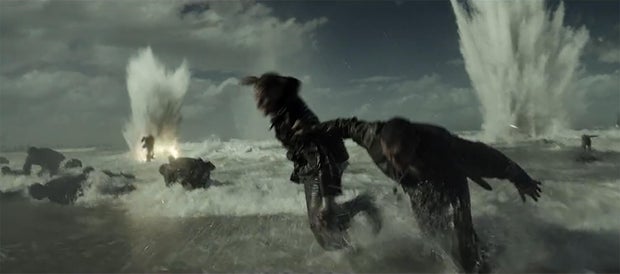
Berg’s immersive style of filmmaking uses real flame throwers and real explosions. It’s also his style of research. For “Friday Night Lights,” he spent a season with a high school football team in Texas. For “Lone Survivor,” he spent a month with Navy SEALs in Iraq.
He wrote most of the script for “The Mosquito Bowl” on Parris Island. “Just gets into your blood,” he said. “And then I carry that, I try to, onto the set. And that’s why I don’t worry about the marks, I don’t care if your jacket looks perfect, I don’t care about the lighting; I want the soul.”
For Berg, these recruits at Parris Island are the human cost of future wars. “It’s a very, very powerful force,” he said. “It’s a very dangerous group of human beings. And I do feel responsibility.”
To understand Berg, you need to understand that his father was a Marine who served during the Korean War. “My father’s buried at Arlington,” he said. “And I love my father very much. I go to his grave and I have conversations with him now. They’re great, because I get to talk, and he has to listen!”
He said he’d already told his father about “The Mosquito Bowl.” When asked what he told him, Berg choked up and excused himself. “Very emotional for me,” he later explained. “I told him I was sorry that he couldn’t see this film. He would have loved this film.”
It’s named after a football game played on the island of Guadalcanal shortly before the Marines shipped out for Okinawa. “A football game which really, to me, only matters as an opportunity for these young men to remember what’s good about life,” Berg said.
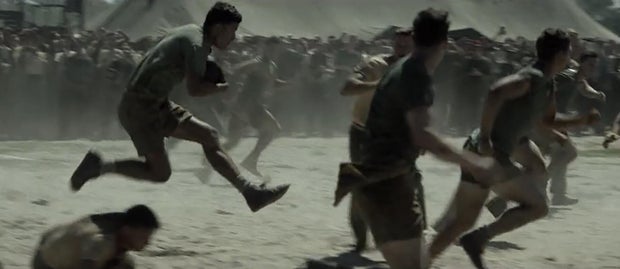
“That football game was a big event. That was a big deal,” said Neal McCallum. Now 99, he hadn’t turned 18 yet, but he was there. He’d joined the Marine Corps ten days after his 17th birthday. “I wanted to get in the war and do my part,” he said.
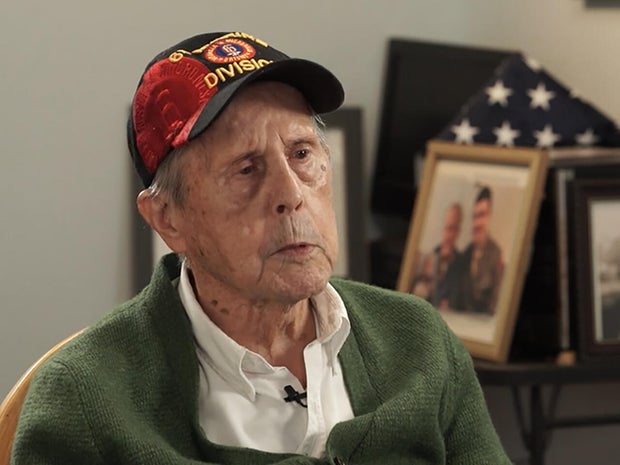
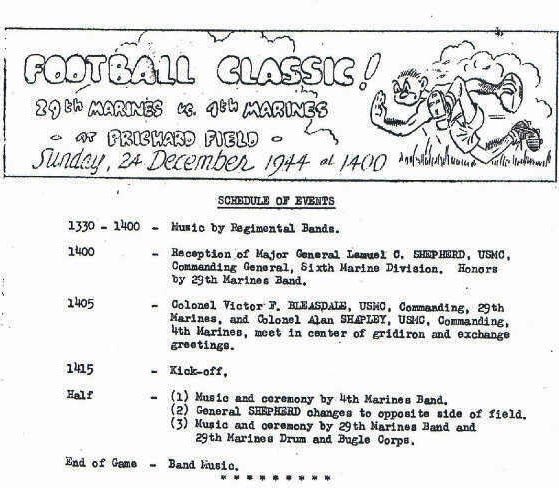
McCallum’s memory, plus a photo of the opening handshake and a mimeographed program, are all that remain of the game between two Marine regiments, each loaded with college football stars.
“Oh, it was a great game, back and forth, so it was a tie,” said McCallum. The final score: 0-0. “They wanted to play again, but the colonel of the 4th Marines said he could not take that chance and hurt his Marines, because he knew we were going into battle soon.”
The battle was Okinawa, and Berg, who started out as an actor, plays the commanding general, telling his Marines, “There’s nothing I would like more than to tell you it’s going to get easier. It’s not. I would love to tell you there will be no more casualties, no more deaths. That’s not true.”
Berg recreated the hellscape of Okinawa in a quarry in Australia, although nothing can recapture the horrors of that 82-day battle. “The casualties on Okinawa [were] just insufferable, and it was a great sacrifice, a big sacrifice,” said McCallum. “Of course, these young guys, their lives were ended. They didn’t have opportunities like I did. I survived the war.”
More than 12,000 Americans were killed, including 15 of the football stars who played in the Mosquito Bowl. And, as Berg shows, the loss of life for Japanese soldiers and the civilians of Okinawa was almost unimaginable.
“How can you forget something like that?” McCullum asked. “It was so intense, you’re not going to forget about it.”
You might not remember the exact numbers, but Berg has tried hard to make sure you never forget the human cost of war. “I want you to feel like you’re going through it,” he said. “I want people to say, ‘I felt that. I felt it. I didn’t think about it, but I felt it.'”
To watch a trailer for “The Mosquito Bowl,” click on the video player below:
Story produced by David Rothman. Editor: George Pozderec.
For more info:
- “The Mosquito Bowl” opens in theaters October 30; streams on Netflix beginning Nov. 25
- “The Mosquito Bowl: A Game of Life and Death in World War II” by Buzz Bissinger (Harper), in Hardcover, Trade Paperback, Large Print Trade Paperback, eBook and Audio formats, available via Amazon, Barnes & Noble and Bookshop.org
- The Battle of Okinawa (National World War II Museum)