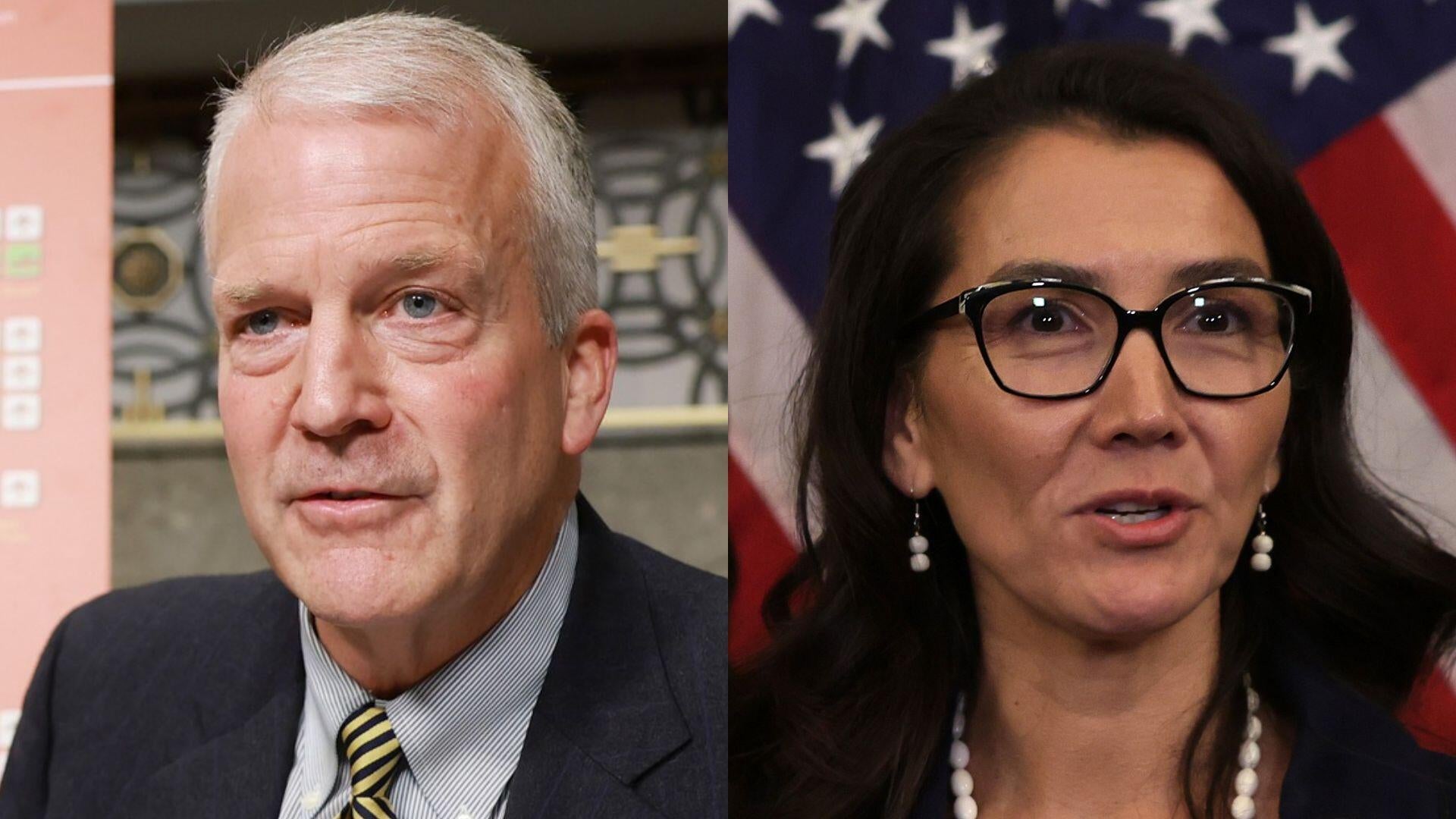
Washington — A candidate bearing nearly the same name as sitting Sen. Dan Sullivan has drawn scrutiny in Alaska’s Senate race, as Republicans and the Trump administration raise the alarm bells over the possibility of confusing voters.
And although the Democrat in the race, Mary Peltola, has denied any involvement, new reporting from The New York Times details an alleged secret effort by people aligned with her campaign to help recruit the second Dan Sullivan.
The race between Sullivan and Peltola has appeared closer than initially expected in a state that President Trump won by double digits in 2024. But the second Sullivan has added a wrinkle.
Here’s what to know about the Alaska Senate race:
How did two Dan Sullivans end up on the ballot?
Alaska voted to change its election system in 2020, introducing a nonpartisan primary and a ranked-choice general election. The unique system, which was first implemented in 2022, aimed to move the state away from party primaries in an attempt to stymie polarization.
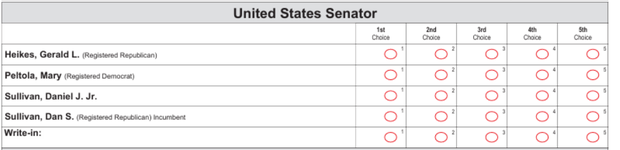
Now, as Alaska voters head to the polls, they face four options for Senate, after the state held a top-four primary in August. The incumbent Sullivan — identified on the ballot as Dan S. Sullivan — is facing off against a candidate by nearly the same name, Daniel J. Sullivan, another Republican, Gerald Heikes, and his main competitor, Democrat Peltola.
Under Alaska’s system, voters can rank as many or as few candidates as they’d like, rather than just selecting a single candidate. If any candidate is the top choice for more than 50% of voters, they win. If nobody wins an outright majority, the count goes to a second round and the candidate with the fewest votes is eliminated, with their supporters’ votes redistributed to their second choice. The process continues until one candidate wins a majority.
Daniel J. Sullivan came in third place in the primary, winning just 2.5% of the vote. Peltola came in first, with 49.5%, followed by Sen. Sullivan, with 41.4%.
Who is the second Dan Sullivan?
Daniel J. Sullivan is a retired teacher from rural Alaska. He announced in June that he was entering the race, prompting a push by the incumbent senator to remove him from the ballot, calling him a “sham candidate” attempting to trick voters. But Daniel J. Sullivan has denied those allegations, insisting that he is genuinely interested in running for Senate.
After the second Sullivan announced his bid, an Alaska election official determined in June that he was not eligible to appear on the ballot, citing a “determined effort and a deliberate attempt” to confuse Alaska voters. Elections Director Carol Beecher said at the time that Sullivan’s entry into the race was not done to “declare an actual good-faith candidacy for the office of United States Senator, but was instead filed with a purpose to confuse or mislead and to thereby compromise the ballot’s fairness or neutrality.”
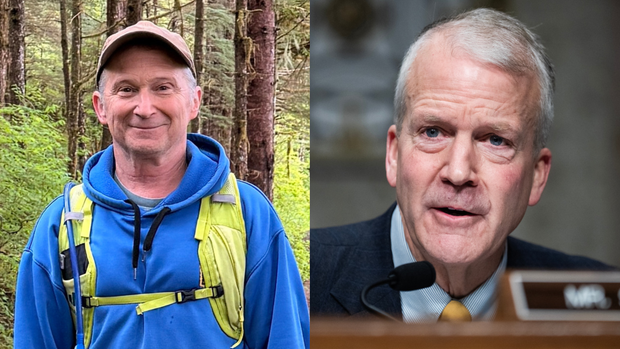
Beecher noted that at one point, Daniel J. Sullivan tried to file as just “Dan Sullivan,” despite never using that iteration of his name to vote, that he tried to list “S” as his middle initial — the same initial as the incumbent senator — and that the two campaign websites looked similar, suggesting a “deliberate” appropriation of Sen. Sullivan’s campaign. Beecher also said he initially asked to be listed as a Republican, but the state had no record of affiliation with the GOP.
But the challenger appealed the decision, and a judge overturned Beecher’s move to keep him off the ballot later that month, finding the state didn’t have the power to decide whether a candidate is running in “good faith.” The state Supreme Court upheld the decision days later, paving the way for both Sullivans’ names to appear.
A sample ballot shows how the two Sullivans are listed, with Daniel J. Sullivan appearing first, as “Sullivan, Daniel J. Jr.,” with no party affiliation, and Sen. Sullivan appearing next, as “Sullivan, Dan S. (Registered Republican) Incumbent.”
For Republicans, the ballot differentiation is the best-case scenario — although they would prefer the second Dan Sullivan not to appear on the ballot. But as Election Day has approached, the GOP has been efforting to make that distinction clear and prevent any confusion, reaching out to voters throughout the state, including with a radio jingle that says, “Dan S., Daniel, Gerry – just don’t rank Mary!”
Reported campaign ties spur questions
Republicans have claimed for months that Daniel J. Sullivan has ties to the Democratic Party. But after The New York Times reported that a Democratic operative who worked with Peltola’s campaign and national Democrats helped encourage him to run, citing text messages and interviews, Alaska’s Republican Gov. Mike Dunleavy ordered an investigation into the Peltola campaign.
“Today’s New York Times reporting reveals disturbing new evidence of an organized effort to manipulate Alaska’s elections by recruiting candidates — including one with the same name as an incumbent U.S. Senator — to deliberately confuse voters and misdirect their votes,” Dunleavy wrote in a post on X.
Dunleavy said the Alaska Division of Elections investigated “these very concerns” earlier this year, adding that the new reporting “substantially supports the Division’s findings.” He said he was directing the Department of Public Safety to investigate “whether this scheme violated Alaska’s laws and whether criminal charges or civil action are warranted.”
A spokesperson for Sen. Sullivan’s campaign said in response to the Times’ reporting that “Alaskans deserve the truth.”
“Mary Peltola and her campaign have spent months gaslighting Alaskans, denying a scheme they were running all along,” Nate Adams said.
The Times reported that the operative’s work to encourage Daniel J. Sullivan to run appeared to be part of a wider effort to draw more candidates into the race. But Peltola’s campaign has denied any involvement in getting Daniel J. Sullivan on the ballot, and a spokesperson for the Democratic Senatorial Campaign Committee said it “is not involved with Dan J. Sullivan.”
Peltola called the reporting “just another distraction” at a campaign stop Wednesday.
“This is all stuff to sell newspapers,” she added.
The Democratic Senatorial Campaign Committee has also argued that in the Senate primary and in prior elections, Republicans engaged in their own efforts to stack the Alaska ballot in order to help their preferred candidates.
Trump administration intervenes
The Times’ report came after the Justice Department filed a lawsuit last week to preemptively challenge the certification of Alaska’s Senate race if Sen. Sullivan loses.
If Sen. Sullivan were to lose because of votes unintentionally cast for Daniel J. Sullivan, the Justice Department argued that the election should not be considered valid. It alleged that he deliberately sought to confuse voters by running with the same ballot name — and, initially, party affiliation — as the incumbent senator.
Attorney General Todd Blanche emphasized on “Face the Nation with Margaret Brennan” Sunday that the DOJ’s lawsuit is “not saying, ‘don’t certify.'” But if a court determined that the race was decided “because of confusion, and not the will of the voters,” then the Justice Department does not think the state should certify the election. He added that the Justice Department was looking to “put guardrails in place” with the move.
Blanche said it may “be obvious from the results and from the ballots that voters were confused,” adding, “That could be obvious from the way that they rank the Dan Sullivans, or not including a Dan Sullivan on the ballot.”
On Wednesday, Mr. Trump wrote in a post on Truth Social, “I don’t think Mary Peltola, after perpetrating such a terrible scheme, should be allowed to run, because this is ELECTION FRAUD.”
The administration has faced criticism for filing the lawsuit less than two weeks ahead of Election Day, a move that Mr. Trump said came at his direction. The Peltola campaign called the DOJ’s move “a despicable political threat to overturn an election.”
GOP Sen. Lisa Murkowski of Alaska, the state’s other senator who’s not up for reelection this cycle, opposed the lawsuit, saying, “Alaskans don’t need any help voting for their preferred candidates and the State of Alaska has already handled this by clearly distinguishing the candidates on this year’s ballot.”
But after The New York Times’ reporting, Murkowski was critical of the Peltola campaign, saying, “Alaskans deserve the honest truth from Mary and her campaign,” calling the revelations a “pattern of lies and coverups and a culture of deception that belongs nowhere in our elections or among our elected officials.”
The pushback isn’t expected to change much ahead of Election Day. Under the Constitution, states have the primary authority when it comes to the “times, places, and manner of holding elections.”
“The Alaska courts have already considered whether or not this might be shenanigans, and they’ve ruled on this under Alaska state law,” election law expert and CBS News contributor David Becker said. “The DOJ’s lawsuit doesn’t have any legal basis, it’s not going to stop certification. The voters of Alaska are still going to decide this race.”
Becker said there is “almost certainly no crime committed here or nothing illegal about what’s happened.”
“These kind of shenanigans unfortunately happen quite a bit. This has happened on both sides of the aisle,” Becker said. “This isn’t unusual — it’s unfortunate.”